
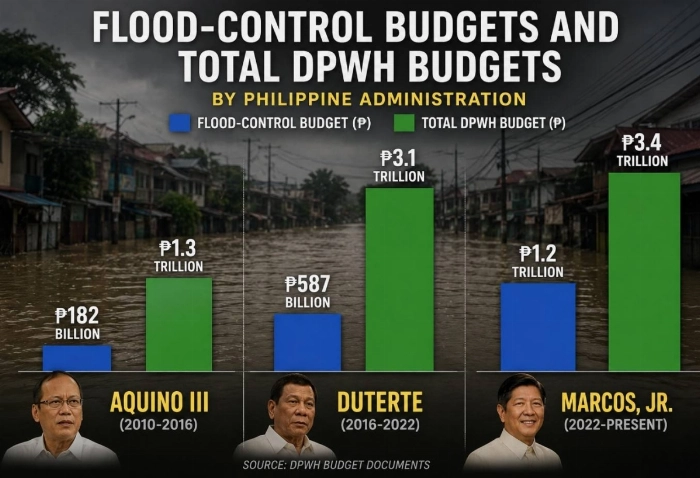
Marcos’ flood-control funds doubled to P1.2 trillion, from Duterte’s P587 billion
FORMER public works and highways secretary Rogelio Singson has revealed — the first time this has been made public — that the government had another public works budget called the “Convergence and Special Support Program,” or CSSP, amounting to P1.1 trillion from 2022 to 2024: P352 billion in 2022, P388 billion in 2023, and P410.9 billion in 2024. Singson said this category became another major scam for anomalous and ghost projects.
The projects covered a broad range of infrastructure: roads and bridges leading to major public facilities, coastal projects, flood mitigation and drainage works, farm-to-market roads, dredging, multipurpose buildings, local water systems and health centers. Singson said many of these projects did not have the required supporting technical studies, project unit-cost estimates and specifications.
These figures were revealed by Singson in a speech last week before the Philippine Construction Arbitration Conference. The speech has provided what may be one of the clearest insider accounts yet of how the massive anomalies in government infrastructure spending developed, pointing not only to dishonest contractors or fictitious flood-control projects but also to hundreds of billions of pesos in projects inserted by legislators at different stages of the national budget process.
Singson was one of five members of the fact-finding body, the Independent Commission for Infrastructure (ICI), set up in September last year by President Marcos purportedly to investigate corruption in flood control and public works projects. The commission concluded its mandate six months later on March 31, 2026, and its findings have not been released to the public.
The ICI submitted its 125-day report to President Marcos and subsequently turned over to the Ombudsman all the documents, evidence and findings gathered in its investigation. But the complete ICI findings have never been released to the public. Only portions — hearings, accomplishment reports, individual referrals and some interim findings — have been disclosed. Malacañang left the matter of publicizing the full findings to the Office of the Ombudsman and the Department of Justice. The Ombudsman has argued that premature disclosure could jeopardize its investigations. Critics say the ICI report went straight to the Ombudsman’s wastebasket.
Every stage
Singson said infrastructure-project insertions occurred at virtually every important stage of budgeting: during the DPWH’s own preparation of its proposed budget, in the House of Representatives, in the Senate, and finally during the bicameral conference committee.
At their peak in the 2024 budget, Singson estimated these insertions across roads, bridges, flood control, and convergence projects at an extraordinary P450 billion to P500 billion.
The significance of Singson’s account is that it presents the flood-control scandal not simply as a collection of isolated ghost projects but as a systemic breakdown in the way enormous amounts of infrastructure money entered the national budget.
The numbers Singson presented show just how dramatically flood-control spending increased.
For the 2011-2016 period when Benigno Aquino III was president, total DPWH appropriations amounted to P1.324 trillion, of which flood control accounted for P182 billion, or about 14 percent.
For 2016-2021 during Rodrigo Duterte’s term, DPWH appropriations increased to P3.135 trillion, with flood control accounting for P587 billion, or 19 percent. And from 2022 through 2025, under the current Marcos administration, DPWH appropriations totaled P3.378 trillion, of which an extraordinary P1.166 trillion — or 35 percent — went to flood control.
Contrast
The contrast becomes even more striking when measured against what Singson says the country actually needed. According to him, the flood-control master plans for the Philippines’ 18 major river basins, covering some 62 provinces, could have been completed within five to six years for approximately P800 billion to P900 billion.
In other words, the amount poured into flood control over the succeeding decade was roughly twice the amount Singson estimates would have been required to complete the major river-basin master plans.
Yet the country — as demonstrated in the massive floods that hit Metro Manila and other areas recently — plainly did not emerge from this spending spree with its major flooding problems solved.
Scandal
This is crucial to understanding the scandal. The controversy therefore cannot be measured simply by adding up projects officially labeled “flood control.” Potentially questionable expenditures were buried in other DPWH capital-outlay categories as well.
The scale consequently becomes much larger than the value of the handful of ghost projects that have attracted public attention.
Singson also described how politically inserted projects became engineering absurdities. Some flood-control projects, he said, were approved and contracts awarded using specified geographic coordinates. When the final surveys were undertaken, however, the coordinates turned out to be different.
Instead of reconsidering whether the project should proceed, Singson said the politician who had sponsored the insertion could insist that the project be constructed somewhere anyway — “basta may project.”
The result was that infrastructure could be constructed in the wrong location without having been properly cleared by the appropriate approving authorities. Singson said many such projects subsequently remained unfinished, were suspended, or had their contracts terminated.
His description exposes one of the fundamental problems with politically inserted infrastructure. A legitimate flood-control system is not simply a concrete wall placed beside a river. Flood management requires hydrological studies, engineering design and integration into a larger river basin or drainage plan. A project chosen primarily because a politician wants an appropriation in a particular locality can therefore be wasteful even when concrete is actually poured.
Ghost
A “ghost project” is the most blatant form of corruption because taxpayers pay for something that does not exist. But an unnecessary, badly located or technically unsupported project can squander public money almost as effectively while leaving behind enough concrete to create the appearance of accomplishment.
Singson provided an even more disturbing example involving the DPWH’s First Bulacan District Engineering Office. There, ghost projects involving P2 billion in monthly disbursements were supported by what he described as spurious documents using a borrowed private contractor’s Philippine Contractors Accreditation Board license.
His description exposes one of the fundamental problems with politically inserted infrastructure. A legitimate flood-control system is not simply a concrete wall placed beside a river. Flood management requires hydrological studies, engineering design and integration into a larger river basin or drainage plan. A project chosen primarily because a politician wants an appropriation in a particular locality can therefore be wasteful even when concrete is actually poured.
Ghost
A “ghost project” is the most blatant form of corruption because taxpayers pay for something that does not exist. But an unnecessary, badly located or technically unsupported project can squander public money almost as effectively while leaving behind enough concrete to create the appearance of accomplishment.
Singson provided an even more disturbing example involving the DPWH’s First Bulacan District Engineering Office. There, ghost projects involving P2 billion in monthly disbursements were supported by what he described as spurious documents using a borrowed private contractor’s Philippine Contractors Accreditation Board license.
The post Marcos’ flood-control funds doubled to P1.2 trillion, from Duterte’s P587 billion first appeared on Rigoberto Tiglao.
Marcos’ flood-control funds doubled to P1.2 trillion, from Duterte’s P587 billion
Source: Breaking News PH

No comments: